Thursday, March 17, 2011

A couple more random thoughts about Bamboozled

·         It was very interesting to me that in the movie, Bamboozled, there were only three white characters prominent enough in the story to merit names and 2/3 of them believed they were black and the other 1/3 of them had made it their life’s work to become an “expert” on being black.

·         If the takeaway from this movie is that race is an essential element of each individual, therefore not subject to changing no matter how that person may wish to reinvent themselves, then the conclusion we have to draw is that reinvention can only apply to behavior. You can not control WHO you are; you can only control HOW you act.

Wednesday, March 16, 2011

Whole Lotta Trickery Goin On!

If a person watched only the first half of Bamboozled, they would probably come away from that experience convinced that Pierre Delacroix was the trickster. He manipulates his situation by creating a minstrel show, Mantan: The New Millennium Minstrel Show, as a way of trying to get one over on his boss and the network he works for, in order to get fired which would release him from his contractual obligation to the network.


In doing this, he appears to display many of the attributes of the trickster: He undermines the unspoken rules of the culture with regard to race. He pits his intelligence and wit against his racist white boss, who holds the power in the situation. He seeks to enlighten the masses with his show, expecting the audience to respond with outrage. Certainly, he creates chaos, as depicted in the scene where the Reverend Al Sharpton and Johnnie Cochran lead protests against the show. He plays on long-held stereotypes and assumptions of the audience (though he makes the mistake of believing that the audience didn’t really subscribe to those stereotypes).

Had the film ended with Pierre’s dismissal from the network known as “CNS”, and his landing a writing job with another network, where his efforts to launch a new show that would cast black people as intelligent, positive role models, we would all applaud his skill as the trickster in getting over on the folks at CNS. But somewhere along the line, Pierre’s efforts at playing the trickster went horribly wrong, and the situation spirals completely out of his control. He ends up dead, and so do several other characters.

Maybe the real trickster in this film is Pierre’s assistant, Sloan. After all, she is the only one who went into the creation of the show with her eyes wide open, and unlike Pierre, she was able to still keep that focus, even after the show was a success instead of resulting in Pierre’s dismissal.

On the other hand, maybe the racially-insensitive boss, Thomas Dunwitty, is the real trickster. He is, in the end, just about the only character in the movie who has not suffered some sort of loss by the end of the film. In fact, it’s not a far stretch to imagine that for him, life goes on as usual after the deaths of both his writer and his former star, as he viewed their talents as “nothing special” and easily replaced.

If this movie is considered a modern commentary on the trickster figure, I think the message is that you’d better be careful when you set out to play the trickster because things may not turn out the way you foresee and your trickery may backfire on you. Then the joke is on you.


Monday, March 14, 2011

Annotated Bibliography for Essay 2

Brenda Forrey
English 201
Instructor: Scott Weaver
Annotated Bibliography Essay 2
14 March 2011


Annotated Bibliography

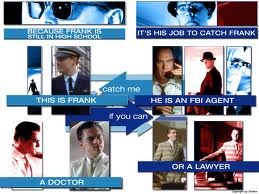
Catch Me If You Can. Dir. Stephen Spielberg. Perf. Leonardo DiCaprio, Tom Hanks, Martin Sheen, Christopher Walken. Dreamworks Video. 2003. DVD. This movie details the life and crimes of Frank Abagnale, Jr., who swindled millions of dollars from unsuspecting corporations by the time he was nineteen years old by posing as an airline pilot, a doctor, an attorney and a prosecutor, and perpetrating check fraud schemes. I may use this movie as one of my literary texts to compare to my definition of “hip”.
 Chandler, Raymond. “Red Wind.”  Stories and Early Novels. Ed. Frank McShane. New York: Literary Classics of the United States. 1995. 368-417. Print. This is a short story about a private detective who witnesses a murder, becomes involved with the woman the murder victim was supposed to be meeting, and ends up a target of the perpetrator of the crime. He ultimately solves the mystery surrounding the murder and recovers a string of pearls belonging to the woman that the murder victim was using to blackmail her. This story is one of the literary texts I will be analyzing in this essay.
 Hemmingway, Earnest. “The Killers.”  Scribd. Scribd., Inc. n.d. Web. 11 March 2011. This is a short story set in the early 20th century about a pair of killers who visit a small town diner in search of their mark. It is one of the literary texts I will analyze in this essay to see how it lines up with my definition of “hip”.
Leland, John.  Hip: The History.  New York: HarperCollins, 2004. Print. This book analyzes the history of the evolution of American pop culture and provides the basis for a definition of “hip”.  Mr. Leland serves as a reliable source due to his history of writing about pop culture, and the exhaustive notes and index included with the book are indicative that this work is based on solid research and not merely opinion. I plan to use extensive quotes from this book to establish my personal definition of hip for this essay. This definition, in turn, will be the structure for analyzing the literary texts I’m looking at to determine the “hipness” factor associated with each.
Ray. Dir. Taylor Hackford. Perf. Jamie Foxx, Regina King, Kerry Washington. Universal Studios. 2005. DVD. This movie details the life and musical career of Ray Charles.  This source may serve as a text for the purposes of this paper.  I plan to analyze this movie to see how it compares with my definition of “hip.”
The Confidence Man. LOST: The Complete First Season. By J.J. Abrams, Jeffrey Lieber, Damon Lindelof. Perf. Matthew Fox, Josh Holloway, Evangeline Lilly, Dominic Monaghan, Terry O’Quinn. Buena Vista Home Entertainment. 2005. DVD. Disc 2. This episode sheds light into the character known as Sawyer, how dealings with a confidence man destroyed his family and how he became a confidence man himself.  This source may serve as a text for the purposes of this paper.  I plan to analyze this episode to see how it lines up with my definition of “hip.”

Wednesday, March 9, 2011

On Catching a Trickster

If you can con millions of dollars by the time you are nineteen years old by posing as a pilot, a doctor, an attorney and a prosecutor, you just may be a trickster. Such was the case of Frank Abagnale, Jr., upon whose life-escapades the movie, Catch Me If You Can, was based.


Now, what, specifically made Mr. Abagnale, Jr. a trickster?

·         He undermined the rules of the culture. “Rules of the culture” could be another way of saying “Laws.” Most of Frank’s money gathering depended on his ability to forge checks and impersonate certified professionals. Highly illegal activities.
·         He worked alone. He was not part of a group and didn’t associate with a clique in his trickster activities.
·         He used wit and ingenuity to win. His cons were not based on physical strength; rather they had their genesis in being smart and creative enough to conceive of and execute actions that moved him toward his goal of amassing wealth through illegal means.
·         He used language as power. Frank Abagnale, Jr. was a slick fast-talker. He used his gift of gab to convince people that he had received professional certifications, which in turn, gave him a platform from which to launch his check fraud schemes.
·         He brought enlightenment to the masses. Not willingly, and not at first, but eventually, as a way to serve part of his sentence, he ended up working in the check fraud unit of the FBI, helping these federal agents shut down other check fraud criminals.
·         He crossed boundaries while undermining them. This man was all about breaking the law, and yet, there is something about the brilliance of his crimes that demands respect from law- abiding citizens and even the FBI check fraud unit. Regardless of personal scruples that keep most people well within the bounds of the law, his cleverness opens the door to imagining perpetrating similar schemes and so escaping the restrictions we allow our society to impose upon us.

“Where most criminals try to leave no evidence, the con artist builds a monument to his creativity and wit.” —John Leland (170).


I wonder if having your life story immortalized in both written and film form qualifies as a monument?

Monday, March 7, 2011

Finding Ray

Poor Mr. Charles.

 As we look towards the bright and shining future that includes a hip dissection of a few literary works, my thoughts have turned to Ray Charles. He hardly gets a mention in John Leland's book, Hip, The History. I wonder why that is. I am contemplating using the movie "Ray", which is based on the life and career of Ray Charles, as one of my literary texts for this essay.

Now I wonder if I am on the right track. . . . hmmm. I think Ray Charles probably was hip. I just wonder why Leland only mentions him peripherally. Maybe he's one of those people that Leland indicated in his preface "fell through one of the many holes in this book" (1).

Well, I'm going to see if I can find him as I look through the lenses of my "hip" goggles. 

Wednesday, March 2, 2011

Perfection of Imperfection - is this a win/win or a lose/lose?

            Looking at the two qualities that Leland attributes to the Beat generation artists, the “aesthetic of imperfection” (140) and the “license of living in the present tense” (155) and trying to sort out the influence of one on the other is a little like trying to solve the age-old question of “Which came first, the chicken or the egg?” They are interminably intertwined and co-dependent upon one another.
             One has to wonder if the Beats would have so readily embraced the idea of putting their most imperfect work on display if they had not simultaneously exercised the license of living in the present tense. If there is no future, consequences for past mistakes will never have the opportunity to wreak their havoc. If the consequences will never come to fruition, there is no need to worry about the imperfections that would have spawned them. It’s either a win/win proposition or a lose/lose proposition but so long as the future doesn’t really exist, who really cares? By embracing the idea of the eternal present the Beats erased the threat that putting their mistakes on display would have posed to the time-bound mortal.
            I don’t believe that art is an act that necessarily must strive for perfection. That is what mathematics is for. Or engineering. It is the imperfections in art that allow the audience to see that the product is created by human minds and hands, and the flaws can serve to inspire the creative genious of the audience. Just like when you go to the movies to see a film such as Inception and you leave the theater puzzling over the loose ends of the threads that weren’t quite neatly tied up by the film’s end; these imperfections allow you to insinuate your own ideas into the art and perpetuate the creative process.

Monday, February 28, 2011

Fitting a square peg in a hip hole

Our first essay assignment was to write about the hippest person we personally know. No one came immediately to mind. Over the course of several days, I finally decided to write about someone very close to me. Though on the surface, he does not fit the stereotype of a “hip” person (what IS that, anyway?), I do think he has qualities that fit the definition of hip when looked at through the lenses of reinvention and self-expression. Mostly though, I felt this assignment was very much like trying to fit a square peg in a round hole. . . not easy and kind of messy.

What follows is my first essay in its entirety. It is very long and not in a format that is very web-friendly; it is, after all, an essay and not a blog post. I am not completely satisfied with this product and will most likely refine and revise if given the opportunity. But for the time being, this is how I defined “hip”:

Mirror, Mirror on the Wall, Who’s the Hippest of Them All?
            “Can you see him? Is he there, in the balcony?” The blind girl next to me in the choir routinely had me searching the crowd for her boyfriend—he had elevated being fashionably late to a hip art form. Okay, so she’s not entirely blind, just too vain to wear the glasses that would render her world in crisp outlines, choosing instead to focus on the clearer, nearer images, and depending on the kindness of those around her to describe the fuzzy, shadowy images beyond. It’s a wonder she never killed anyone driving around that way.
I scan the assembled crowd, skimming over the short and overweight and dark-haired, concentrating on finding the young man with the center-parted, perfectly feathered hair the color of wheat ready for harvest. Shorter than some, taller than most, with the broad shoulders and thin hips of a young man well-acquainted with the rigors of the weight room, he cuts an impressive figure when he enters a room. His wool and leather letterman’s jacket, white sailcloth pants and Puma sneakers mark him as an athlete, along with the rest of his circle of friends. Looking for him has become a habit for me. Hip demands an audience, and I am his.
            Months later, the blind girlfriend is out of the picture and I find myself standing on the edge of an outdoor pool, shivering in the chilly June breeze. The Oregon day is deceptively sunny. I am anchored to the spot by the obligation of holding his class ring while he dives into the razor sharp frigidness of the pale green unheated water. He is the only one of a hundred of us who braves the pool. Doing what others only briefly think about doing is what he is all about. The simple request, “Hey, will you hold my ring?” seems pretty straightforward, but it contains ambiguous code which demands, “Notice me!” and implies, “You’re going to spend the rest of your life watching me do things my way.”  His language is hip—studiously cloaking the real message from the outside world.
            He serenades me with a commercial jingle for Dr. Pepper, dancing ahead of me, not caring what those who look on think of his singing and dancing skills. He will never win any fine arts competition, but he steals my heart by refusing to take himself too seriously. Eventually, we find ourselves in a candlelit church and with the exchange of rings and the simple words, “I do,” he is transformed from the carefree boy who sings, “I’m a Pepper, you’re a Pepper, he’s a Pepper, she’s a Pepper. Wouldn’t you like to be a Pepper, too?”  Who is he now? He is about to find out.
            He brings his firstborn son home. He will do nothing for the next twenty years without considering the impact on this one. This birth (and the two that come later) is the catalyst for multiple reinventions of the man. The first comes within the year.
            He announces he is going to go back to school. He cannot bear the thought of assuming the family carpet cleaning business. He is husband/father/student. Every role defines him, and he is true to himself in excelling at every one. A marginal student in high school, he distinguishes himself by earning a place in the University’s Academic Hall of Fame. He gently breaks the news to his own father that he has chosen a different path. He will not be a carpet cleaner. He will not embrace the status quo. He will be his own man. The family business will be no more.
He finds that the work he does occupies time and provides for his family, but it is not who he is. Honors and promotions stoke his ego and ease financial burdens, but they do not complete him. He looks for ways to honor the essence of who he is and finds that coaching his kids’ sports teams gives him the opportunity he craves to develop knowledge and share it with a select few. He becomes not a businessman who coaches in his spare time; rather he is a coach who finds time to be a businessman. “This goes towards my ‘dad of the year’ award, right?” becomes a frequent refrain. I know what he means. It’s not really about being the best coach; it’s about being the best dad.
He knows something the other baseball coaches do not know: you can take a ragtag bunch of mediocre players and form them into a winning team, not by depending on their skill or perfect mechanics, but by strategizing the plays. He wins countless games against superior teams with this knowledge. I watch him call plays from the third base line with a combination of signals and code phrases he taught to his players. It is a thing of beauty to those who know the code and a source of frustration to those who have yet to crack it. Who would have ever guessed that America’s favorite pastime could be so hip?
“Dude! We were like truckin’ dude down that hill, dude, like so fast, Dude! I mean, dude, it was, dude, unreal! DUDE!” The boy’s verbal skills were neatly matched by his social skills. The man laughingly counted “dpm’s” and growled “Kris—go home!” when he overstayed his welcome. But when the troubled kid who had no father was kicked out of the house by his overwhelmed mother, this man took him in. He showed the kid how to consider his options, make a clean break with his past, see potential in himself. By the time the boy returned to his mother’s home, the “dudes per minute” count and growled phrases about going home had worked their magic, communicating love and acceptance to one who had experienced very little of that. He doesn’t just talk the talk of helping others, he walks the walk. Other people don’t understand this. Sometimes being this hip is hard.
He wants a cabin. He dreams of mountains, and logs, and heavy equipment. It must be a remote place, built with his own hands. He will be a cabin builder, and his creation will be an extension of who he is. It would be much easier to buy one that already exists, but that would be at odds with his purposes in pursuing this dream. In pouring concrete, and stacking logs, and installing windows, and dealing with building inspectors and all the other minutiae of a project of this magnitude, he is afforded the opportunity to once again gain knowledge that only a select few have, and also to interminably suspend himself in the present time. Once the project is begun, there is no turning back. The pace of the project, coupled with the painstaking process of learning as he goes along, seem to ensure that the future of “when the cabin is complete” will never arrive. Being thoroughly comfortable living in the present, enjoying the process instead of demanding the resolution, is hip. When he puts on his “man pants” and retreats to “man land” he is on the road he calls “living the dream”. It is as though Walt Whitman was speaking directly to his soul in his poem Song of Myself when he penned, “Not I—not any one else, can travel that road for you, / You must travel it for yourself. /  It is not far—it is within reach; / Perhaps you have been on it since you were born, and did not know; / Perhaps it is every where on water and on land” (46.1207-1211). Dreaming the dream is commonplace; living the dream is hip.
His name is Randy, and he is the one person in my life that most closely personifies this maddeningly ambiguous term we are studying this semester, called “hip”.
If “hip” is the reinvention of self as an expression of individualism without regard for the past or the future, then Randy is the picture of hip. In his book, Hip: The History, John Leland argues, “This promise of reinvention—that we are not bound by our pasts—is a core current of hip” (31). He goes on to say that it was “the gospel of individualism that was central to hipsters to come” (Leland 44). When you have reinvention married to the expression of individualism, you get hip. Reinvention in the absence of the expression of individualism is just copycat-ism. Over the course of many years, I have seen varied incarnations of Randy: carefree youth, faithful spouse, father, student, coach, businessman, mentor, dreamer, builder.  It’s not so much the fact that he has been called on to fulfill different roles that makes him hip—lots of people do that. His hipness is born of the intensity and focus with which he dedicates himself to his various roles and his ability to live in the moment. He doesn’t just complete the actions; he becomes what he does. When Leland says, “hip germinated in the off hours” (p 46), he paints a picture of a person who indulges their true identity in the hours spent away from the world of work. Randy may be a businessman by occupation, but he finds his identity in being a husband, father, coach, mentor, dreamer and builder. Business is what he does; the other things are what he is.
Hip involves knowledge and awareness not commonly held, though shared by some within an exclusive circle. According to John Leland, “[hip’s] rejection of conventional wisdom is a reflection on convention, not wisdom” (49). He goes on to say that “enlightenment involves stripping away sophistication, not adding to it” (Leland 49). Randy demonstrated both of these ideas in his approach to baseball, rejecting some more conventional approaches to coaching, but embracing wisdom that allowed him to put the special knowledge he had attained to his best advantage, all while keeping it as much about the basics as possible. The exclusive circle within which he shared his special knowledge was the team he was coaching at the time, and assistant coaches he was mentoring.
Paired with this “knowing” or enlightenment is the invention of slang terms or the use of language to mean something other than the definition dictated by the dictionary. The language of hip involves both humor and ambiguity and according to John Leland, “verbal riffing wants an audience that doesn’t get it as much as one that does” (24). When Randy first grinned and casually said to me, “That’s about 40 dpm’s”, the reference to the oft-repeated word sailed completely over Kris’s head.  Eventually, Kris decoded that message, and it became a favorite joke within our family. Though most people would be offended by having “Kris–go home!” growled in their faces, our friend came to understand that that particular message included an invitation to return another time. Hip language serves a dual purpose: to communicate with those who are “in the know,” as well as to exclude those who are “out of it.”
So, can anybody be hip? Or is hipness limited to a select segment of the population?  Leland contends that hip is the territory of young people because “they have the least invested in the status quo” (22) and that while embracing new technology is easily done by the young, older people are more likely to resist change and “get corny” (61). This is where Leland and I part company. I don’t believe that hipness is tied to a particular age group; it is more closely tied to state of mind than state of body. As a matter of fact, I would argue that if it is hip to reinvent oneself as an expression of individual identity, then the older a person is and the more entrenched they are in the status quo, the greater the impact of a total re-make of identity. Perhaps the potential for hipness actually increases with age.
            Just when you think you have a handle on hip, you find you don’t. It defies concrete definition and dwells in a place of subjectivity.  Probably, the soul group, Tower of Power, said it best in their 1973 song called “What is Hip?” when they crooned: “Hipness is—what it is! / And sometimes hipness is / What it ain’t!” (qtd in Leland 4). Hipness is a lifestyle, the essence of the man who is hip. It looks different on each person. Hip is a circular reference that refuses to be resolved into a nice neat package…but you will know it when you see it.
Works Cited
Leland, John. Hip: The History.
             New York: HarperCollins, 2004.   Print.
Whitman, Walt. Leaves of Grass. Philadelphia: David McKay, 1900. N. Pag. Bartleby.com, 1999. Web. 18 February 2011.